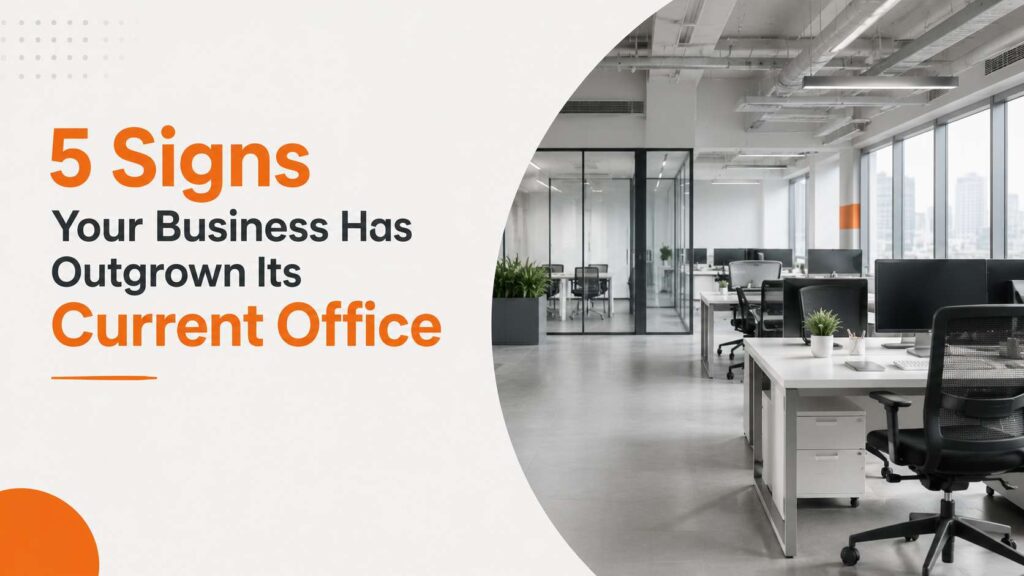
Every growing company hits this moment. The office that once felt spacious and exciting now feels like it’s working against you instead of for you. Desks are squeezed into corners, the good meeting room is booked out three days in advance, and someone on your team is taking client calls from the staircase.
At Vibe Coworking Spaces, we’ve spent the last few years helping startups, SMEs and enterprise teams across Baner, Balewadi High Street, and Aundh in Pune move out of offices that stopped fitting their business and into managed, flexible workspaces that scale with them instead. Having worked directly with founders and operations heads navigating exactly this transition, we’ve noticed the signs tend to repeat themselves, almost like a pattern every growing business eventually walks through. This guide breaks down the five clearest ones, why they matter more in 2026 than they did a few years ago and what growing companies in Pune are doing about it.
1. Your Team Has Outgrown Your Square Footage
This is the sign every business owner recognises first, because it’s the one you can literally see. Desks pushed together to fit one more chair. New hires working from the cafeteria, a corner table, or home because there’s genuinely nowhere left to put them. Storage rooms doing double duty as makeshift workstations.
The tricky part is that this rarely happens overnight. A business usually grows in bursts a new client wins you three extra headcounts, a product launch pulls in a support team, a new department gets added mid-year. Traditional office leases are built around a fixed headcount decided months or years in advance, but real hiring doesn’t move in a straight line. By the time the crowding becomes obvious, it’s usually been building for a while.
If your workspace is starting to shape your hiring decisions instead of the other way around, that’s your first sign.
2. Meeting Rooms Are Always Booked, and Collaboration Suffers
A close second: nobody can find a room. Client calls happen at the pantry table. Important internal discussions get pushed into open-plan areas where half the floor can overhear. Interviews get rescheduled because there’s simply no private space available that week.
This isn’t just an inconvenience it directly affects how your team works together. Modern teams need a mix of focused individual space, informal collaboration corners, and private meeting or conference rooms for client-facing conversations. When your office only offers one type of space, either everything gets forced into it or people start avoiding meetings altogether. Either way, decision-making slows down and client impressions take a hit.
3. Hidden Costs Are Quietly Piling Up
This sign is easy to miss because it doesn’t show up as a single line item it shows up as a dozen small ones. Overflow furniture bought in a hurry. A second internet connection because the existing one can’t handle more devices. Extra housekeeping, extra parking arrangements, ad-hoc IT support calls because your infrastructure wasn’t built for this many people.
Add these up over a year and many businesses discover they’re already spending close to what a properly managed, fully-serviced office would cost, except without the professional infrastructure, community, or flexibility that comes with it. A cramped office isn’t actually the “cheaper” option once you account for what it’s costing you in inefficiency.
4. Your Office No Longer Reflects How Your Business Actually Works
Three years ago, your business probably looked different: smaller team, fewer clients, maybe a different way of working altogether. Hybrid schedules, project-based teams, and client-facing meetings have changed how most companies use their workspace day to day, even if the physical layout hasn’t changed with them.
This is the sign that’s easiest to overlook because it doesn’t announce itself the way overcrowding does. It shows up as a workspace that feels vaguely unproductive rooms that are always the wrong size for what’s happening in them, layouts that don’t support the way your team actually collaborates now. If your space still reflects an older version of your business, it’s quietly holding back the current one.
5. Your Office Is Sending the Wrong Signal to Clients and Talent
Your office is often the first physical impression a client or a candidate has of your company. A cramped, cluttered, or visibly outgrown space can undercut the professional image you’ve worked hard to build elsewhere, even if your product, service or team is excellent.
This matters more in competitive hiring and client markets like Pune, where growing IT, startup and SME businesses are often evaluated on the environment they operate from as much as on their pitch. A space that looks like it’s straining at the seams can quietly cost you the trust of the people you’re trying to win over.
What’s Changing in 2026: Businesses Are Choosing Flexibility Over Fixed Leases
Across the commercial real estate industry this year, one shift stands out clearly: growing businesses are moving away from long-term, fixed-headcount leases and toward managed, flexible workspace models that can scale up or down without disruption. Instead of signing a five-year lease sized for today’s team and hoping it still fits in year three, companies are choosing move-in-ready, fully-serviced offices that let them add seats, rooms or entire floors as they grow with none of the capital investment or setup delay that comes with a traditional office build-out.
Pune is very much part of this shift. The city has firmly established itself as one of India’s fastest-growing technology and startup hubs, and commercial micro-markets like Baner, Balewadi, Aundh and Hinjewadi are seeing sustained demand from startups, SMEs and enterprise teams alike, all looking for the same thing: infrastructure that’s ready on day one and flexible enough to grow with them. Managed office spaces fully furnished, professionally run, and scalable by seat count have become the default choice for companies that don’t want their workspace to be the thing slowing down their growth.
Why Location Matters as Much as Layout
If your business has outgrown its current office, the “where” matters just as much as the “how much space.” For companies operating in Pune’s western business corridor, three micro-markets consistently come up as the strongest fits for growing teams:
- Baner — Home to Pan Card Club Road, one of Pune’s most in-demand commercial addresses, with strong connectivity to Balewadi, Aundh, and the Hinjewadi IT belt, plus a thriving social infrastructure of cafes, gyms, and retail that makes hiring easier.
- Balewadi High Street — A premium, fast-growing commercial destination that’s increasingly popular with SMEs and enterprise teams wanting a polished business address without the Hinjewadi commute.
- Aundh — Well-connected and accessible, a solid alternative for teams who want proximity to Baner and Balewadi without being in the thick of it.
How Vibe Coworking Spaces Solves This for Growing Pune Businesses
At Vibe Coworking Spaces, we built our managed office and coworking model specifically around this outgrowth problem. Whether you’re a startup scaling from 30 to 50 seats, an SME expanding to 100 seats or an enterprise team planning for 500+, our fully furnished, plug-and-play offices in Baner and Balewadi High Street are designed so your workspace grows alongside you instead of holding you back.
Every Vibe location comes with high-speed internet, private cabins, meeting and conference rooms, dedicated community managers, parking, wellness areas, and a genuine professional community all without the capital expense or lead time of building out a traditional office. Rated 4.8 by over 500 professionals and trusted by startups, SMEs and enterprises across Pune, we’ve made moving into a bigger, better-managed space simple and fast.
If your team is spilling out of its current office, don’t wait for the signs to get louder. Schedule a visit to one of our Baner or Balewadi locations.
Reach out at: +91-8208341339 / sales@vibecoworkingspaces.com to find the workspace that actually fits where your business is headed next.
Frequently Asked Questions
- How do I know if my business needs a bigger office, or just better organisation?
A. If the problem is purely clutter, reorganising can help. But if new hires have nowhere to sit, meeting rooms are booked days in advance, or costs are quietly rising from ad-hoc fixes, that’s usually a capacity issue, not an organisation one and it tends to get worse, not better, on its own. - Is it cheaper to move to a managed office space in Pune than to expand our current lease?
A. Often, yes, once you factor in the true cost of a traditional expansion extra furniture, added IT infrastructure, renovation and a new long-term lease commitment. A managed office space in Baner or Balewadi bundles furniture, internet, housekeeping and support into one predictable cost, with the flexibility to scale seats up or down. - How quickly can a growing business move into a new office in Baner or Balewadi?
A. Fully managed, plug-and-play offices are built to be move-in ready. Unlike a traditional lease that can take months to fit out, a managed workspace at Vibe Coworking Spaces can typically onboard a growing team within days of finalising seat count and location. - What size teams does Vibe Coworking Spaces support?
A. Vibe works with startups (30–50 seats), SMEs (50–100 seats) and enterprises (100–500+ seats) across our Baner and Balewadi High Street locations, with Kalyani Nagar opening soon. - Which Pune locations are best for a growing team relocating from a smaller office?
A. Baner and Balewadi High Street are currently the strongest choices for growing teams, thanks to their connectivity to Aundh and the Hinjewadi IT corridor, professional business environment and strong local amenities. Both are well suited to startups, SMEs and enterprise teams alike.