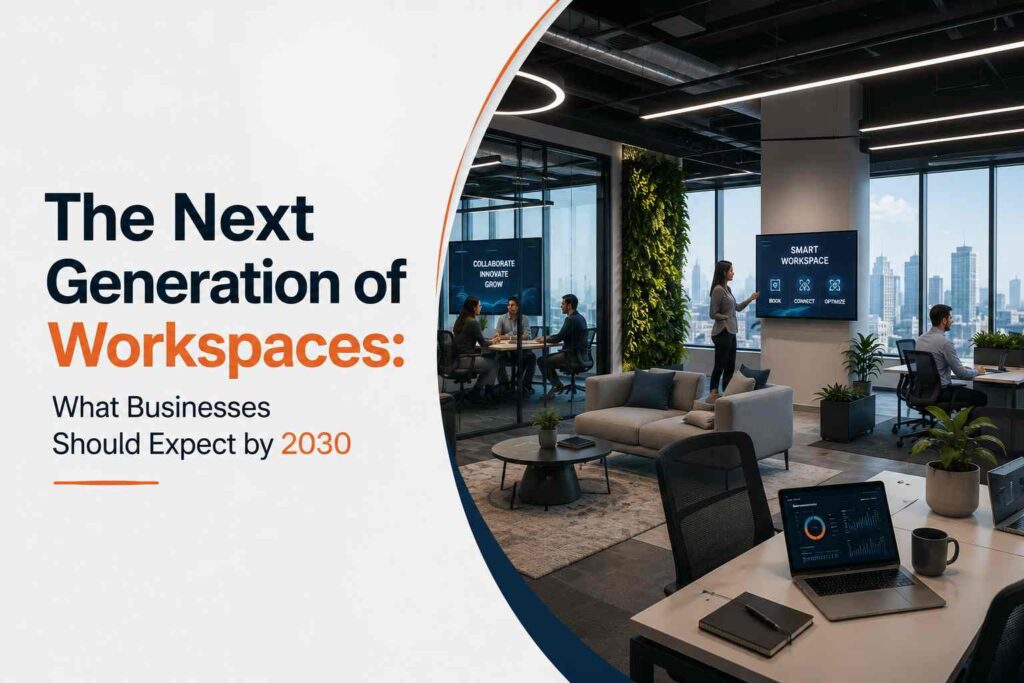
Ask any business owner what an office was for a decade ago and the answer was simply a place to put desks and get work done. Ask that same question today and the answer is already more complicated a hub for collaboration, a tool for hiring, a signal of brand identity, a space that has to justify itself against the option of just working from home. By 2030, that question is still going to get more complicated.
At Vibe Coworking Spaces, we don’t just watch this shift from the sidelines we build for it, every day, across our managed workspaces in Baner and Balewadi High Street. Having worked closely with startups, SMEs and enterprise teams navigating exactly how much office they need and why, we’ve had a front-row seat to how fast expectations are moving. This piece looks at where workspaces are actually headed by 2030, what the research and early movers are already telling us and what growing Pune businesses should be planning for now not later.
From Fixed Leases to Flexible Memberships
The single biggest shift already underway is the move away from long-term, fixed leases toward workspace models that behave more like a subscription than a real estate commitment. Businesses no longer want to commit five or ten years to a space sized for today’s headcount and hope it still fits three years from now. By 2030, industry analysts expect workspace access to work much like joining and leaving a streaming service easy to scale, easy to adjust, easy to walk away from without a multi-year penalty hanging over the decision.
This isn’t a minor convenience. It fundamentally changes how businesses plan. Instead of budgeting for office space once and revisiting it only when the lease is up, companies will treat workspace as an ongoing, adjustable line item something that flexes with hiring, project cycles and market conditions in real time, rather than something locked in years in advance.
Hybrid Isn’t a Phase It’s the New Default
The pandemic-era experiment with remote and hybrid work has settled into something more permanent: a genuinely distributed way of working, where teams split time between home, flexible offices near where they live and centralised hubs for collaboration. By 2030, most organisations aren’t expected to mandate a single way of working they’re expected to design around a mix, with the office serving a specific, deliberate purpose rather than being the default location for every task.
This changes what an office actually needs to do well. It has to justify the commute by offering something home that can’t focus on meeting spaces, in-person collaboration, community and infrastructure rather than simply being rows of desks people are required to occupy. Offices that don’t earn their place in a hybrid routine will increasingly sit empty, regardless of how much a business is paying for them.
Technology Woven Into the Building, Not Bolted On
Smart building technology is moving from a nice-to-have to a baseline expectation. Occupancy sensors that show real-time desk and meeting room availability, app-based booking that removes the back-and-forth of finding a free space, and data-backed insights into how a workspace is actually being used are becoming standard features of well-run offices, not premium add-ons.
Some forecasts go further still, describing offices where individual work preferences, lighting, temperature, even desk ergonomics adjust automatically as an employee arrives. Whether every business needs that level of personalisation by 2030 is up for debate, but the underlying direction is clear: technology in the workplace is shifting from something IT manages in the background to something that actively shapes the day-to-day employee experience.
Wellness and Hospitality Become Core Design Principles, Not Perks
Offices are increasingly being designed around how people actually feel while they work, not just how efficiently they can be seated. Natural light, air quality, greenery, noise control and comfortable, hospitality-inspired interiors are moving from optional extras to core design priorities, driven by a straightforward business reason: workspaces that feel good to be in are a genuine factor in attracting and retaining talent.
This is part of a broader trend of hospitality thinking entering office design treating employees and visitors less like occupants of a functional space and more like guests in a well-run environment. Businesses that get this right by 2030 aren’t just building nicer offices; they’re building a tangible advantage in competitive hiring markets, where the workplace experience increasingly factors into whether someone accepts an offer or stays.
Sustainability Moves From CSR Slide to Core Design Brief
Sustainable design is shifting from a checkbox exercise to a defining feature of how workspaces are planned from the ground up: energy-efficient lighting, better natural light use, waste segregation and smarter resource management are increasingly built into a workspace’s foundations rather than added after the fact. For businesses, this isn’t just about environmental responsibility; it’s increasingly a factor employees and clients notice and factor into their impression of a company.
By 2030, workspace sustainability is expected to be less about isolated green initiatives and more about buildings designed holistically around efficient resource use a shift that growing businesses will increasingly expect from any managed office provider they choose.
Adaptable, Multi-Purpose Layouts Replace the Static Floor Plan
The one-size-fits-all office layout is fading. In its place: modular, easily reconfigurable spaces where furniture, partitions and zones can shift to match what a team actually needs that week a large workshop one day, several smaller focus pods the next. Hot-desking and activity-based zones are expected to dominate over permanently assigned seating, both to use space more efficiently and to match how flexibly modern teams actually work.
For growing businesses, this means office layout stops being a fixed decision made once at move-in and becomes an ongoing capability one that has to flex as easily as headcount and project needs do.
What This Means for Businesses Planning Ahead in 2026
None of this is a distant, 2030-only concern. The direction is already visible today, which means the businesses that adapt earliest gain a real advantage better talent retention, lower unplanned costs and infrastructure that doesn’t need replacing every time the company changes shape. Choosing a workspace partner already built around flexibility, technology, wellness and adaptable layouts today is effectively choosing not to have this conversation again in a few years.
Preparing Pune Businesses for the Workspace of Tomorrow
For businesses in Pune thinking ahead to what workspaces will look like by 2030, the starting point is choosing a location and provider already built around flexibility, not against it:
- Baner — Anchored by Pan Card Club Road, one of Pune’s most in-demand commercial addresses, with strong connectivity to Balewadi and the Hinjewadi IT corridor and a growing ecosystem of amenities that supports the hospitality-driven, wellness-first direction workspaces are heading toward.
- Balewadi High Street — A premium, fast-growing business destination where SMEs and enterprise teams are increasingly choosing managed, flexible workspace models over traditional long-term leases, positioning themselves ahead of where the market is headed.
If your team is already searching “managed office space Pune” or “flexible office space Baner” while wondering whether your current lease will still make sense in a few years, that instinct is worth listening to. The businesses planning for 2030 today are the ones that won’t be scrambling to catch up later.
How Vibe Coworking Spaces Is Already Building for What’s Next
At Vibe Coworking Spaces, our Baner and Balewadi High Street locations are built around exactly the direction workspaces are heading flexible seat scaling instead of rigid long-term leases, fully-furnished and technology-enabled spaces, community-driven amenities and layouts designed to adapt as teams grow and change.
Whether you’re a startup scaling from 30 to 50 seats, an SME growing toward 100, or an enterprise team planning for 500+, we’ve designed our workspaces so you’re not just solving today’s space problem you’re choosing a model built to keep up with where workspaces are genuinely headed. Rated 4.8 by over 500 professionals and trusted by growing businesses across Pune, we help you plan for tomorrow’s workspace today.
If you want a workspace built for where business is headed, not just where it’s been, let’s talk. Schedule a visit to our Baner or Balewadi location or reach out at +91-8208341339 / sales@vibecoworkingspaces.com to see what a future-ready managed office actually looks like.
Frequently Asked Questions
- How will office leases change by 2030?
A. Businesses are expected to move away from long-term, fixed-term leases toward flexible, subscription-like workspace models that let them scale seats up or down without the penalties and rigidity of traditional multi-year commitments. - Will remote work replace offices by 2030?
A. Unlikely. Instead, most organisations are expected to embrace a distributed, hybrid model where the office serves a specific purpose of collaboration, community and infrastructure rather than being the default location for all work. - What role will technology play in future workspaces?
A. Smart building features like occupancy sensors, app-based room booking, and usage analytics are becoming standard in well-run offices, helping businesses use space more efficiently and giving employees a smoother day-to-day experience. - Is it worth choosing a flexible managed office space now instead of waiting until 2030?
A. Yes businesses that adopt flexible, technology-enabled, wellness-focused workspaces earlier tend to see better talent retention and fewer disruptive relocations, since they’re not stuck adapting a rigid traditional lease later. - Which Pune locations are best positioned for the future of flexible workspaces?
A. Baner and Balewadi High Street currently offer the strongest combination of connectivity, managed infrastructure and flexible, scalable workspace models for startups, SMEs and enterprise teams planning ahead.