
Summary
The office decision has changed. Businesses no longer choose space only by square footage or monthly rent. They now look at setup time, operational burden, employee comfort, flexibility and how quickly the workspace can support growth. That is why the debate between managed office space and traditional office leasing has become so relevant for modern companies. Managed offices are fully furnished, move-in-ready spaces where the provider handles maintenance, utilities, reception and other daily support. Traditional leases usually give the business more control, but they also demand more capital, time and internal management.
In Pune, this topic matters even more. Flexible workspaces took a 16.4% share of India’s office absorption in H1 2025, and Pune’s office market showed strong leasing momentum through 2025, even as supply tightened and rents rose in early 2026. That combination tells us one thing clearly: businesses want offices that work faster, cost less to manage and adapt more easily to changing team needs.
Table of Contents
- What managed office space really means
- What traditional office leasing really means
- Why businesses are moving toward managed office spaces
- Managed office space vs traditional office leasing
- The hidden costs businesses often forget
- Which model fits which type of business
- Why Pune is leaning toward flexible workspaces
- Why Vibe Coworking Spaces fits this conversation
- Final thoughts
- FAQs
1. What managed office space really means
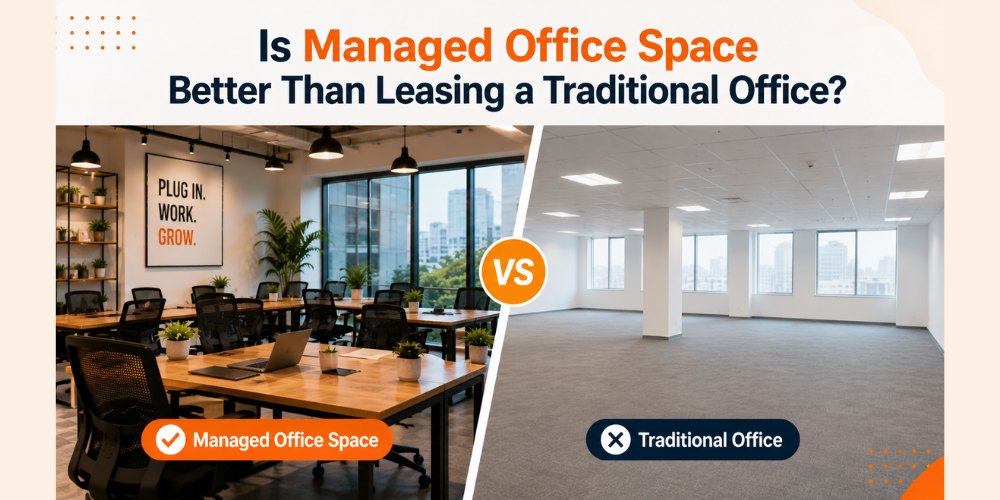
A managed office space is built for convenience. The office is already furnished and ready to use and the operator handles the operational side of the workspace. That usually includes internet, maintenance, cleaning, reception support, security and other everyday requirements that businesses otherwise have to arrange on their own. The key idea is simple: the company moves in and starts working, instead of spending months building the office first.
That is why managed office spaces are increasingly seen as a practical answer for businesses that care about speed and predictability. They remove the slowest part of office setup and replace it with a more structured monthly cost.
2. What traditional office leasing really means
Traditional office leasing works differently. The business usually takes a bare or partly built space and then manages the rest itself. That means fit-outs, interiors, cabling, furniture, utilities, repairs and day-to-day office operations all sit with the company. The upside is total control over layout, branding and infrastructure. The downside is the amount of time and capital required before the office becomes usable.
For large, stable organizations, that control can still be valuable. A traditional lease can support deep customization, permanent brand identity and long-term planning. But the trade-off is rigidity. Once the space is set, changing direction becomes expensive and slow.
3. Why businesses are moving toward managed office spaces
Most modern teams do not want office management to become a second business inside the business. They want to focus on growth, customers, hiring, delivery and performance. That is the main reason managed office space has grown so quickly across enterprise, startup and hybrid-work segments. Companies get a fully equipped workplace, predictable monthly billing and less operational friction.
This is especially relevant for businesses that are expanding into new cities or opening satellite teams. A managed office allows them to start faster, reduce setup risk and avoid locking too much money into interiors and infrastructure before the model is proven.
4. Managed office space vs traditional office leasing
Setup speed
Managed office spaces are built for immediate use. Traditional offices often need months of fit-out work before a team can move in. For businesses that care about time-to-market, that difference matters a lot.
Upfront capital
Managed office space helps companies avoid large initial CapEx on furniture, interiors and IT infrastructure. Traditional leasing usually demands a much heavier upfront spend before operations even begin.
Flexibility
Managed offices are easier to scale up or scale down. That makes them a strong fit for startups, fast-growing teams and hybrid workforces. Traditional leases are much less flexible because they are tied to longer commitments and fixed spaces.
Monthly predictability
Managed office space usually bundles rent, Wi-Fi, housekeeping, security and support services into one invoice. That makes budgeting easier. Traditional offices often start with rent but accumulate additional operational costs that are harder to predict.
Control and customization
Traditional office leasing still wins when a company wants complete control over design, server rooms, branding and long-term corporate identity. Managed office spaces offer less freedom in that sense, because the workspace is already structured and operating.
Best use case
Managed office spaces are usually better for startups, scale-ups, hybrid teams and businesses entering a new market. Traditional leasing is still a fit for large, stable organizations with predictable growth and a dedicated admin team.
5. The hidden costs businesses often forget
The monthly rent is rarely the full story. In Pune, office running costs can run 40% to 60% above the rent number once housekeeping, electricity, internet, security, pantry, compliance and other operating expenses are included. That is exactly why the traditional office can look cheaper on paper and become far more expensive in practice.
This is one of the biggest reasons managed office space makes sense for growing businesses. It converts many unpredictable office expenses into a bundled workspace cost. That gives companies more control over cash flow and less surprise in monthly planning.
6. Which model fits which type of business
If a business wants deep customization, long-term control and a fixed corporate headquarters, traditional office leasing can still be the right choice. That is especially true for large teams with stable headcount and a dedicated facilities function.
If a business wants faster move-in, lower setup pressure, predictable costs and room to grow, managed office space is usually the stronger option. That is why many startups, hybrid companies and expanding teams are shifting in that direction. The decision is not about which model is universally better. It is about which model matches the stage of the business.
7. Why Pune is leaning toward flexible workspaces
Pune’s office market has been active through 2025, with flexible workspaces taking a meaningful share of leasing demand and the city showing strong gross absorption growth in Q3 2025. Even in early 2026, leasing slowed only because supply was tight and rents were rising, which suggests the demand side remains healthy.
That is important for Baner and Balewadi. These micro-markets sit inside a city where businesses increasingly want practical, ready-to-use offices instead of long setup cycles. Pune is also seeing stronger demand from GCCs and flex-space users, which reinforces the shift toward managed and flexible workplace formats.
8. Why Vibe Coworking Spaces fits this conversation
Vibe Coworking Spaces is positioned exactly where this shift is happening. The brand offers premium managed office spaces in Pune with office options in Baner, Balewadi High Street, and Kalyani Nagar, along with plug-and-play and team-ready workspace options. The site also highlights office space for 30+ employees, private office spaces, shared office space, conference rooms, parking and ready-to-move office solutions.
That matters because the best workspace today is not just about the address. It is about whether the office helps a business move in quickly, work smoothly, meet clients professionally and scale without unnecessary friction. Vibe’s Baner and Balewadi offerings are built around that kind of practical use.
9. Final Thoughts
So, is managed office space better than leasing a traditional office? For many modern businesses, yes. Managed office spaces reduce setup time, lower upfront spending, simplify operations and give teams more flexibility to grow. Traditional office leasing still has a place, especially for large organizations that need deep customization and long-term control.
For Pune businesses, especially in Baner and Balewadi, the case for managed office space is even stronger because the market is moving toward speed, flexibility and operational simplicity. That is exactly where Vibe Coworking Spaces can offer a more useful solution than a conventional office setup.
10. FAQs
- What is the main difference between managed office space and traditional office leasing?
A. Managed office space is ready to use and handled by an operator, while traditional office leasing usually requires the business to manage setup and operations itself.
- Which is better for startups?
A. Managed office space is usually better for startups because it reduces upfront CapEx, speeds up move-in and makes scaling easier.
- When does traditional office leasing make more sense?
A. It makes more sense for large, stable organizations that want complete customization and are comfortable handling office operations internally.
- Why is managed office space growing in Pune?
A. Because businesses in Pune are looking for flexible, ready-to-move and operationally simpler office formats and flex workspaces have been taking a meaningful share of office demand.
- Does Vibe Coworking Spaces offer managed office solutions?
A. Yes. Vibe offers managed office spaces, private office spaces, coworking options and team-ready offices in Baner, Balewadi High Street and Kalyani Nagar.