
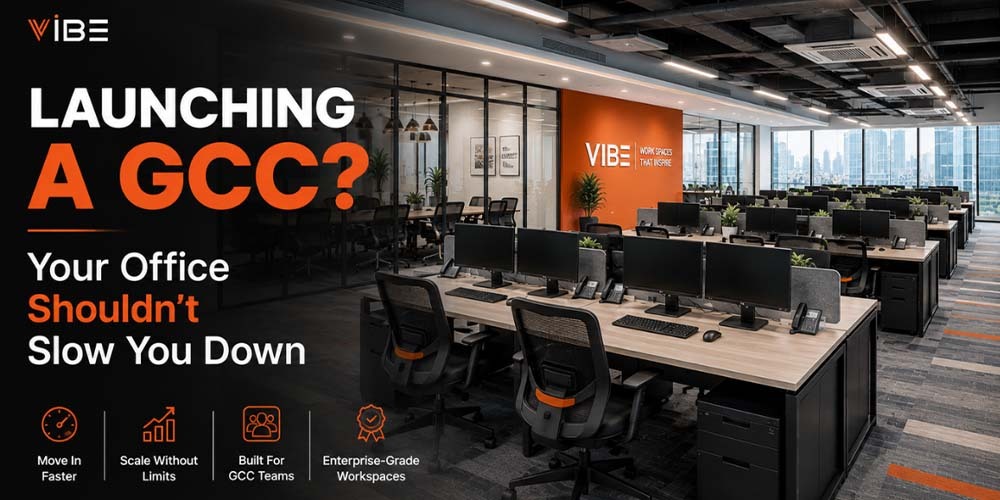
Setting up a Global Capability Center already involves enough moving parts hiring leadership, building out functions, aligning with headquarters on timelines that were probably set before anyone factored in how long a physical office actually takes to stand up in a new country. The office is supposed to be the easy part. For most companies launching a GCC in India, it isn’t.
At Vibe Coworking Spaces, we talk to a lot of companies at exactly this stage global teams with a mandate to get operational in India fast and a workspace decision sitting in the critical path of everything else. This post looks at why office setup has become one of the biggest hidden delays in launching a GCC, what the data says about where this is all headed in 2026 and what a workspace built for GCCs actually needs to look like.
The Delay Nobody Budgets For
Most GCC launch plans account for hiring timelines, compliance and technology rollout in detail. Office setup is usually the part that gets underestimated and it tends to show up as three recurring problems:
- Long office setup timelines: Sourcing a location, negotiating a lease, fitting it out and getting infrastructure installed can take months of time a GCC launch plan often doesn’t have.
- High long-term leasing costs: A traditional lease means committing capital and a multi-year term before the center has even proven its headcount or growth trajectory.
- Facility management overhead: Once the office is running, someone has to manage its vendors, maintenance, IT infrastructure and security none of which is core to what the GCC is actually there to do.
None of these problems are unique to any one company. They’re structural, built into how traditional office leasing works and they hit hardest exactly when speed matters most at launch.
What a GCC Actually Needs Instead
The alternative that’s gained real traction is a fully managed workspace model built around three things:
- Ready-to-move-in workspaces: so a GCC can be operational within days or weeks instead of months.
- Enterprise-grade infrastructure: including the security, connectivity and reliability a global organization expects from day one not something bolted on after move-in.
- Flexible space that scales with the team: so early headcount projections don’t have to be exact and growth doesn’t mean renegotiating a lease every time the center expands.
This isn’t a smaller or scaled-down version of a traditional office. It’s a different way of solving the same problem get a serious, secure, professional workspace running fast, without taking on the capital risk and operational weight of running the building yourself.
Why This Matters More in 2026 Than It Did a Few Years Ago
The pace of GCC expansion into India has accelerated well beyond what most workspace models were originally built to support. Pune alone is now home to well over 360 Global Capability Centers, with momentum pointing toward significantly more by the end of the decade. Nationally, India’s GCC ecosystem has grown to include more than 2,000 centers employing well over two million professionals, and by some industry estimates, GCCs now account for close to two-fifths of all office leasing activity across India’s major cities.
What’s changed isn’t just the volume; it’s the role these centers play. GCCs that once handled narrow support functions are increasingly being asked to own core product work, AI initiatives and strategic decision-making for their parent organizations. That shift raises the stakes on getting the workspace right a center expected to deliver real innovation output can’t afford to spend its first two quarters dealing with facility setup instead of building its team.
Pune specifically has become one of the stronger destinations for this expansion, thanks to its depth of engineering and technical talent and a growing base of Grade A office infrastructure across its business corridors. For companies evaluating where to launch, the city increasingly comes with an expectation that the workspace itself won’t be the bottleneck, which is exactly where a managed office model earns its place.
Comparing Your Workspace Options for a GCC Launch
Most companies launching a GCC end up choosing between a small number of real options, each with a different trade-off:
| Workspace Model | Setup Time | Upfront Cost | Who Manages It |
| Traditional leased office | Several months | High | Your team |
| Serviced or managed office | Days to weeks | Low to moderate | Provider |
| Coworking desks (early-stage) | Days | Low | Provider |
| Build-to-suit campus | 6–12+ months | Very high | Your team, with contractors |
A traditional lease gives full control over design and branding, but at the cost of time and capital a fast-moving GCC launch rarely has to spare. A build-to-suit campus makes sense once a center has proven its scale and is planning for hundreds of seats over several years, but it’s rarely the right starting point. For most GCCs in their first one to three years, a managed office sits in the sweet spot enterprise-grade infrastructure and a professional address, without the lead time or capital commitment of building it yourself.
The Real Cost of Getting This Decision Wrong
A GCC that loses two or three months to office setup doesn’t just lose time; it loses momentum with headquarters, delays hiring because there’s nowhere for new joiners to sit and often ends up paying for temporary or stopgap arrangements while the “real” office gets finished. None of this shows up as a single dramatic failure. It shows up as a launch that quietly slips its own timeline, one delay at a time, until the center is playing catch-up before it’s even fully staffed.
This is precisely the gap a managed workspace is built to close not by cutting corners on infrastructure or professionalism, but by removing the setup timeline as a variable altogether.
GCC-Ready Workspace in Baner and Balewadi
For organizations evaluating a GCC launch in Pune’s western business corridor, location and infrastructure need to work together from day one:
- Baner — Anchored by Pan Card Club Road, with strong connectivity to Balewadi and the Hinjewadi IT corridor, giving a new GCC easy access to Pune’s established technology talent pool.
- Balewadi High Street — A premium, professional business address that supports the kind of enterprise-grade first impression a GCC needs when leadership, clients or headquarters teams visit.
Both locations are built for exactly the scale a GCC launch requires not a handful of desks, but infrastructure that can grow from an initial team into a full-floor operation without a disruptive move.
How Vibe Coworking Spaces Helps GCCs Get Operational Faster
At Vibe Coworking Spaces, we help GCCs get operational faster with enterprise-grade infrastructure, flexible office solutions and end-to-end workplace management across our Baner and Balewadi High Street locations. That means no long setup timelines, no high upfront capital commitment and no facility management burden landing on your team’s plate just a workspace that’s ready from day one and built to scale as your center grows.
If you’re comparing this approach against a traditional lease, it’s worth reading how hidden costs quietly build up in the wrong workspace decision or how managed offices remove daily administrative work that would otherwise fall on your operations team.
Planning a GCC launch in Pune?
Book a consultation and let’s discuss your workspace requirements
Call: +91-8208341339
Email: sales@vibecoworkingspaces.com
Visit: vibecoworkingspaces.com to get started.
Frequently Asked Questions
1. What is a GCC and why does office setup matter so much for one?
A: A Global Capability Center (GCC) is a dedicated office a multinational company sets up in another country to run core functions like engineering, technology, analytics or operations. Since a GCC is usually launched against a tight timeline set by headquarters, delays in office setup directly push back when the center can start delivering.
2. How long does it typically take to set up a traditional office for a GCC?
A: Sourcing a location, negotiating a lease and completing a fit-out for a traditional office can take several months. A managed, ready-to-move-in workspace can reduce this to days or weeks, since the infrastructure is already in place.
3. Is a managed office space suitable for a large or scaling GCC team?
A: Yes. Managed office models are specifically built to scale, letting a GCC start with a smaller footprint and expand seats or floors as headcount grows, without renegotiating a long-term lease each time.
4. Why is Pune a strong location for launching a GCC?
A: Pune has built a deep base of engineering and technology talent alongside a growing supply of Grade-A commercial infrastructure, making it one of India’s established GCC hubs alongside cities like Bengaluru and Hyderabad.
5. What should a company look for in a managed office provider for a GCC?
A: Enterprise-grade infrastructure, strong connectivity and security, a location that supports both talent access and a professional first impression, and a provider who can handle facility management end-to-end so the GCC’s own team can focus on operations, not building maintenance.