
I have watched the same story play out in Pune for more than twenty years. A founder signs a three-year lease for an office sized for the team they hope to have. Eighteen months later the team is either far bigger than the space or far smaller, a product line has been dropped, a client has moved and the lease is still running. Nobody made a bad decision. They just made a fixed decision for a business that never stayed fixed.

Businesses change shape all the time. A workspace that can’t change with them ends up costing more than the rent on the page. That is why a flexible workspace for a growing business in Pune is worth understanding before anything gets signed, and it is what the rest of this guide covers.
What Actually Changes as a Business Grows
It helps to look at what really shifts, because it is rarely just headcount.
- Team size: Five people become twelve, then thirty. Sometimes a project ends and it drops again.
- Where people work: A hybrid team may need a full floor on some days and almost nothing on others.
- How the space is used: An early-stage team mostly needs desks and a decent internet connection. A year later it needs a private room for client calls, a board-style space for investors, and a place for the whole group to sit together once a week.
- How much attention the office takes: At ten people, someone can sort out the internet provider on a free afternoon. At forty, that same job quietly eats a person’s week.
A fixed office handles none of this well. A flexible one is built around it.
A Workspace That Grows in Stages
Over the years I have seen most healthy businesses move through roughly the same sequence. Not every company follows every step, and nobody should be pushed along faster than their business needs. But the pattern is useful.
Stage 1: Test the space with a day pass: A freelancer, a founder just starting out, or someone new to the city doesn’t need a long commitment. A day pass in a professional setting, with a proper desk, fast WiFi and a quiet corner, is a low-risk way to find out whether a place fits the way you work.
Stage 2: Add meeting rooms as clients appear: The first real client is usually the moment the kitchen table stops working. Booking a meeting room by the hour gives you a proper setting for that conversation without paying for space you won’t use the rest of the week.
Stage 3: Move to a regular base: Once the work becomes steady, a fixed desk or a small private area gives the team a routine and a place to keep things.
Stage 4: Take a managed office: When the team is large enough to need its own space, a managed office gives you a furnished, staffed floor that is ready to use. Internet, housekeeping, security and upkeep are handled for you, so nobody on your team has to run a building.
Stage 5: Scale up, or down, without starting over: The real value of the earlier stages is that you aren’t forced to restart the search every time something changes.
Where the Savings Come From
Most people compare office options on monthly rent. After watching many of these decisions up close, I’d suggest looking at four other things:
- Fit-out and furniture: A traditional office means spending on desks, chairs, partitions and wiring before anyone sits down. A managed office is already set up.
- Time to move in: A typical fit-out takes months. A ready office takes days. For a team that needs to start hiring, that difference matters.
- Running costs: Utilities, internet, housekeeping, security and repairs add up and are hard to forecast separately.
- Exit cost: If the business changes direction, how expensive is it to leave? With a long lease, the answer can be very expensive.
Put those together and the cheapest-looking rent is often not the cheapest option in practice.
What Vibe Offers at Each Stage
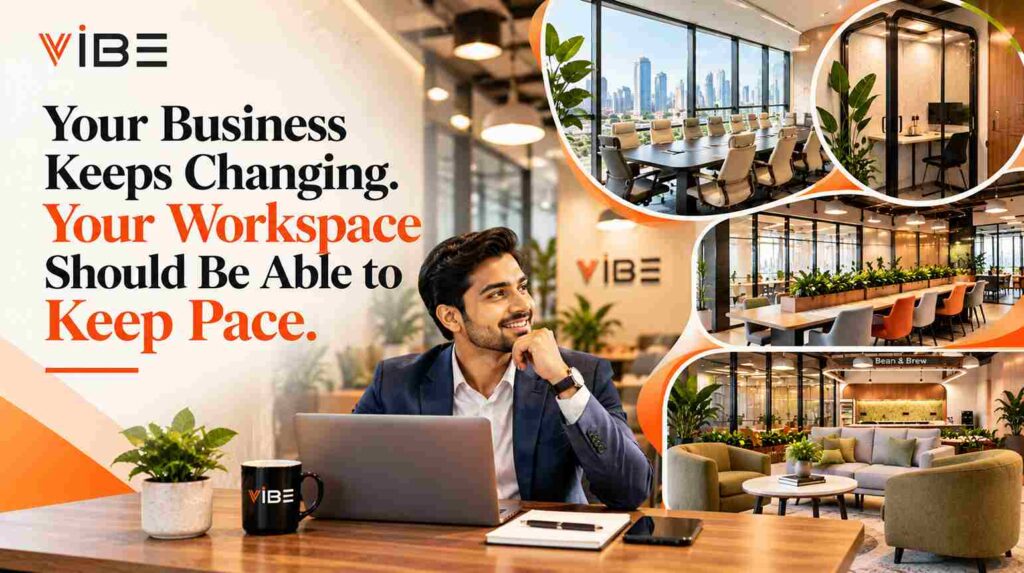
At Vibe Coworking Spaces, the Baner and Balewadi centres are set up so a business can use whichever format fits the moment, from the same operator, in the same part of Pune.
- Day passes for freelancers, remote professionals and anyone testing the space.
- Meeting rooms on demand, booked by the hour, for client calls, interviews and reviews.
- Conference rooms for larger groups and longer sessions.
- Coworking desks for people who want a regular place to work among other professionals.
- Private offices and managed office spaces for teams that need their own, fully looked-after space.
A team can start at one end and move toward the other as the business develops, without changing neighbourhoods or starting a new search.
Why Baner and Balewadi Suit Growing Teams
Baner and Balewadi sit on the western business corridor of Pune, close to Aundh, Wakad and the Hinjewadi IT belt. Both areas have good road access and metro connectivity, and both are close to restaurants, hotels and client-friendly venues. For a growing team that is hiring, being easy to reach matters. Candidates come from across the city, and clients often visit from other parts of Pune or from out of town.
Vibe operates from Baner One on Pan Card Club Road and from Solitaire Business Hub on Balewadi High Street.
Questions to Ask Before You Commit to Any Workspace
If you are weighing a flexible workspace against a traditional lease, these questions will tell you most of what you need to know:
- Can I add or reduce seats without renegotiating everything?
- What exactly is included in the monthly cost?
- How quickly can my team move in?
- Can I book meeting rooms when I need them without a separate contract?
- What happens if my plans change in six months?
If the answers are vague, take that as information too.
See Which Stage You Are In
If your business has outgrown its current setup and you are looking for a flexible workspace in Pune, or you are not sure what comes next, the easiest thing is to see the space in person. Vibe Coworking Spaces offers Coworking Spaces with day pass access, meeting rooms, conference rooms, private office spaces, and managed office spaces across Baner and Balewadi.
👉 Book a Workspace Visit at Vibe
📞 +91-8208341339
📧 sales@vibecoworkingspaces.com
Frequently Asked Questions
- What is a flexible workspace?
A. A flexible workspace lets a business choose the amount and type of space it needs, such as a day pass, a desk, a private office or a managed floor, without a long fixed lease. - When should a growing business move from a coworking desk to a managed office?
A. When the team needs its own private space, a consistent layout and room to hold meetings without sharing, a managed office usually makes more sense than a shared desk. - Can I book a meeting room in Baner or Balewadi by the hour?
A. Yes. Meeting rooms at Vibe can be booked on demand. Call +91-8208341339 to check availability for your date. - Does Vibe offer a day pass?
A. Yes. A day pass gives you a workstation and access to shared facilities for a single day, with no long-term commitment. - Where are Vibe’s centres in Pune?
A. Vibe has centres at Baner One on Pan Card Club Road and at Solitaire Business Hub on Balewadi High Street.